

Why Your New Battery Dies Faster (And What’s Actually Going On)
Why “New” Batteries Can Perform Worse
By Dane Grant | Utah Tech Repair
If you've ever received a "new" replacement battery that somehow dies quicker than the last, you're not alone. We’re about to start a support group...
Lithium-ion batteries provide power by pushing a flow of electrons through your device. That flow is what powers everything—your screen, your apps, all of it.
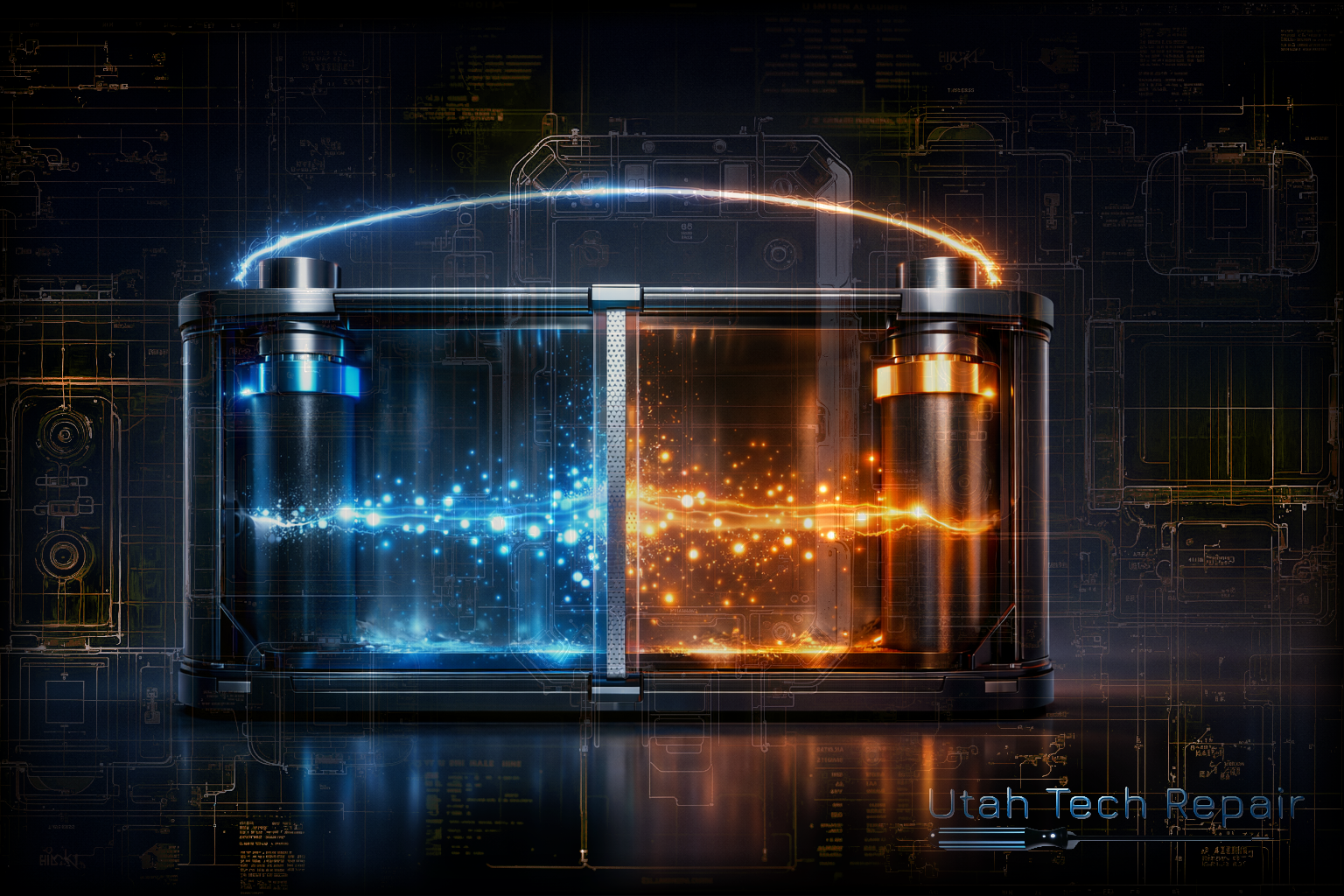
Inside a battery cell, you essentially have two posts standing in a room—like exes at a party. And let’s really emphasize how opposite these exes are: one is positive, the other is negative. (Yeah, I went there.) Their friends have formed a barrier between them to prevent direct contact. Not a solid wall—but more like a filter to prevent them from ruining the party. It allows certain things through, but not everything. (And because it's Utah, the punch bowl in the middle is Gatorade.)
So inside this “room,” you’ve got:
- two opposite terminals (positive and negative)
- a porous separator between them (their friends blocking direct interaction)
- and a liquid electrolyte solution filling the space (the Gatorade)
What’s Actually in the “Punch Bowl”
That liquid electrolyte isn’t just random fluid—it’s what allows lithium ions to move. Here’s the key distinction:
- A lithium atom = has an electron (neutral)
- A lithium ion (Li⁺) = missing an electron (positive)
Inside the battery, lithium mostly exists as positively charged ions (Li⁺) moving through the liquid—not a mix of free-floating positive and negative lithium atoms. The electrolyte’s job is to let those Li⁺ ions travel between the two sides.
What Happens When You Turn Your Device On
When your device powers on:
-
Lithium atoms at the negative side split:
Li → Li⁺ + e⁻ -
The electron (e⁻):
travels through your device — this is the power -
The lithium ion (Li⁺):
moves through the liquid electrolyte
passes through the separator toward the positive side (See the cool picture at the top of the article for reference!)
Those two movements are linked:
- if ions can’t move, electrons stop
- if electrons stop, your device shuts off
Back to the Party
Let’s bring it back to the party. Someone tells the negatively charged ex that their ex is at the party. They start spreading gossip—which really gets things going. (Yes, that’s your power turning on.) That gossip travels around the room (through your device) and reaches the other side. Meanwhile, their mutual friends quietly move through the punch bowl (the electrolyte), carrying the message across the room to keep things balanced. And the cycle continues.
The Problem (Why Batteries Wear Out)
Here’s the catch: Every time this process happens, a few “friends” get stuck or choose a side and stop moving.
And over time:
- fewer lithium ions are available to move
- the pathways get clogged
- the system slows down
Eventually… The party dies.
The Hidden Catch (Even When You Don’t Use It)
But here’s the caveat… The battery doesn’t have to be in use for this process to occur. (Just like friends can pick sides without even hearing the gossip.)
Even sitting on a shelf:
- chemical reactions are still happening
- lithium is still getting trapped
- the system is still degrading
And heat makes it worse. A battery stored in a hot warehouse for months can age like one used for years. It’s not guaranteed—but it happens more often than you’d think.
What Age Does to Batteries
In addition to losing longevity and function, batteries can also expand and become fire hazards. Humans aren’t the only ones who let themselves go.
Remember that electrolyte solution inside (the Gatorade at the party)? Over time, it breaks down chemically and produces gas. That gas builds up inside the sealed battery. With nowhere to go, the battery swells.
In the tech world, we call these “spicy pillows.”
If you want nightmares, search for laptop or phone batteries catching fire. I’ve personally seen it happen in a MacBook. It adds a whole new meaning to the phrase "don't drink the cool-aid". This is why proper disposal (which we handle) is a must.
What This Means for You (TL;DR)
The good news:
- most sellers will replace a bad battery
- with proper documentation, you’re usually covered
The reality:
- batteries can arrive bad before you ever install them
- and the pressure often falls on the technician to prove it
(Any guesses why this is our conversation topic today?)
by: Dane Grant